FG rolls out agricultural reforms, targets 21m new jobs
FG rolls out agricultural reforms, targets 21m new jobs
The Federal Government on Tuesday announced a range of new incentives aimed at boosting agricultural investment, with the potential to generate 21 million jobs nationwide.
As part of President Bola Tinubu’s economic agenda, the government also committed to reforms focused on expanding irrigation, improving access to credit, and creating millions of rural employment opportunities.
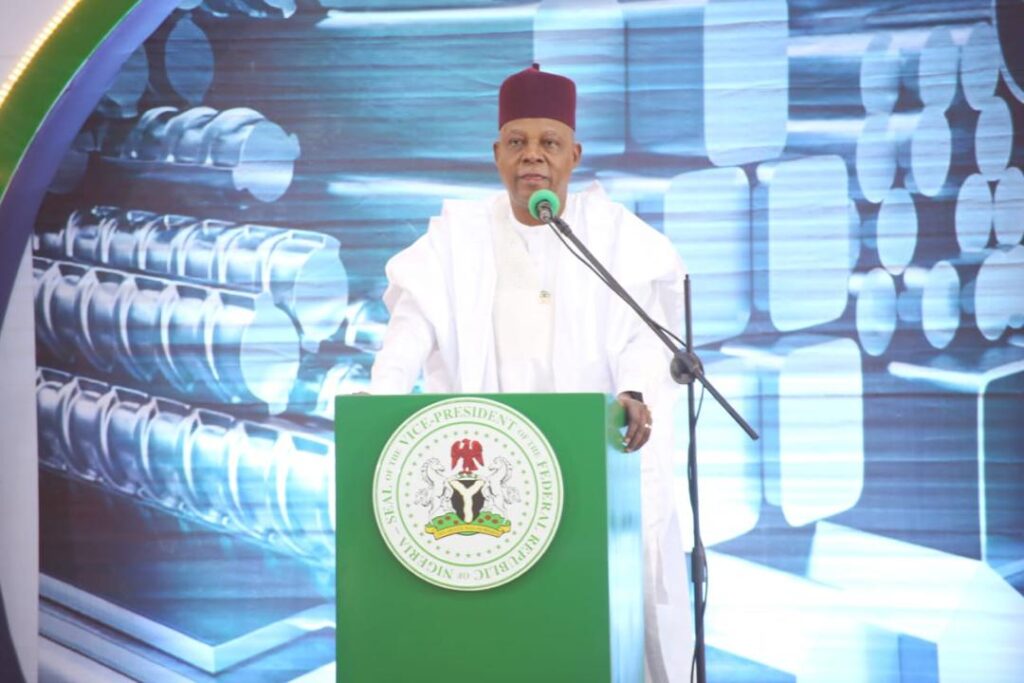
Vice President Kashim Shettima, speaking at the Food and Agriculture Organisation’s National and Subregional Hand-in-Hand Investment Forum in Abuja, described hunger as “the great equaliser that exposes our vulnerabilities and the shared fragility of human existence.”
Details of the meeting were disclosed in a statement by the Vice President’s Senior Special Assistant on Media and Communications, Stanley Nkwocha, titled “More Incentives for Farmers as FG Unveils New Agric Investment Incentives.”
The measures include single-window platforms for land registration, strengthened agricultural credit systems, large-scale mechanisation, and strategic irrigation projects.
Tuesday’s unveiling comes as rising food prices and climate shocks have intensified calls for long-term investment in the sector.
Nigeria has been under pressure to cut its reliance on imports and address food insecurity, which worsened after fuel subsidy removal and currency reforms deepened inflation in 2023.
Shettima said Nigeria had the capacity to irrigate more than three million hectares of farmland but currently uses less than 10 percent of that potential.
“Strategic investment in irrigation alone could triple yields, free us from seasonal dependency, and fortify our resilience against climate shocks,” he stated.
“Nothing unifies humanity as much as hunger. It is the great equaliser that reveals our vulnerabilities and the shared fragility of our existence.
“Food is not merely a matter of survival, it is a matter of global security,” Shettima added.
The Vice President noted that Nigeria’s blueprint under the 2021–2025 National Development Plan aims to lift 35 million people out of poverty, create 21 million jobs in rural communities and secure food and nutrition sufficiency.
Shettima specifically observed that irrigation is a game-changer, noting that Nigeria has river basins and aquifers capable of irrigating over three million hectares but currently uses less than ten per cent.
“Strategic investment in irrigation alone could triple yields, free us from seasonal dependency, and fortify our resilience against climate shocks,” he added.
He assured investors that regulatory reforms, public-private partnerships and agri-tech innovations would make Nigeria “open for business.”
“Nigeria is open for business, and we are ready to partner with you. Let us work hand-in-hand to build Nigeria and a sub-region where no one goes to bed hungry, where rural communities are hubs of wealth creation, and where agriculture is the true foundation of our prosperity,” VP Shettima said.
Earlier, the Minister of Agriculture and Food Security, Abubakar Kyari, described Nigeria’s market, large arable land and growing digital economy as unique opportunities for investors.
He said a combination of Nigeria’s domestic market, large arable land, clement weather and fast-growing digital economy present unique opportunities for investment across the agribusiness ecosystem.
For his part, the Minister of Budget and Economic Planning, Senator Atiku Bagudu, said the economic potential of Nigeria remains largely untapped, especially in agriculture and irrigation, which hold significant promise for economic diversification and transformation.
He noted that agriculture, particularly agribusiness, remains a pivotal component of Nigeria’s national development plan in the medium and long term, as well as the Renewed Hope Agenda of President Tinubu.
For his part, the Minister of Agriculture, Livestock and Food Security of The Gambia, Dr Demba Sabally, commended the FAO for hosting the event and Nigeria’s leadership in agriculture, highlighting the country’s success stories in the rice and cassava value chains as worthy of emulation by countries in the sub-region and beyond.
Sabally emphasised the need for peer review among countries in the West African sub-region because of their common challenges and opportunities for growth and transformation.
In the same vein, the representative of the FAO in Nigeria and ECOWAS, Dr Hussein Gadain, said the Hand-in-Hand Initiative is FAO’s “evidence-based, country-led, and country-owned flagship programme, designed to accelerate agricultural transformation and sustainable rural development.”
Gadain said the programme is squarely aimed at eradicating poverty, ending hunger and all forms of malnutrition, and reducing inequalities. It is our vehicle for achieving the SDGs.
Commending Nigeria’s clear agricultural development priorities and describing them as catalysts for transformative and sustainable growth within Africa’s agri-food systems, Gadain hailed Vice President Shettima’s genuine commitment and visionary leadership in transforming Nigeria’s agri-food systems.
According to the FAO rep, the VP’s “passion for agriculture, food security, and nutrition is unmatched. He has been a driving force in attracting crucial investments and fostering innovation, and his continued engagement deserves our highest commendation.”
Also, the Head of the EU Delegation in Nigeria, Mr Gautier Mignot, said the Hand-in-Hand Initiative reflects Nigeria’s strong commitment to strengthen food security and deepen investment across the agribusiness value chain.
He declared that the EU remains Nigeria’s long term partner in Nigeria’s agricultural journey and is committed to investing in value chain development in the country, starting with the recent investment of over 80 million euros to unlock opportunities in key value chains across seven states.
Farmers have reacted to the Federal Government’s announcement of new agricultural incentives, urging that the promises be backed with concrete action, warning that without implementation, the initiatives would amount to little.
The National President of the All Farmers Association of Nigeria, Kabir Kebram, stressed the need for follow-through.
“Of course, these policies will have a positive impact if properly implemented. You can design policies, but without effective execution, there will be no results. We call on the Vice President to actualise his promises and ensure full implementation. That is the only way to truly transform the food system,” he said.
Similarly, the Chairman of the Competitive African Rice Forum, Agric, Peter Dama, cautioned against what he described as a “cycle of promises without delivery.”
“Announcements are different from action. While we welcome these pronouncements, our hope is that they are matched with practicality. For instance, tractors were promised, yet we are already approaching the dry season—have they been delivered? Government should ensure that actions follow words, not months later when the farming cycle has passed. Until then, we can only wait and hope,” Dama said.
The Small-Scale Women Farmers Organisation in Nigeria (SWOFON) also criticised the interventions, arguing that they have not improved food production. In a phone interview, SWOFON National Secretary, Chinasa Asonye, said smallholder women farmers—who form the backbone of Nigeria’s food supply—have yet to benefit meaningfully.
“From our perspective as small-scale women farmers, interventions such as single-digit loans, women-friendly machinery, access to land, and policy inclusion have not been effectively delivered. At best, less than one-third of what we’ve been advocating has been implemented. Policies like the Malabo, CADI, and WSHADA frameworks exist, but are they being applied? The answer is no,” she said.
Asonye further decried the government’s failure to meet the Malabo Declaration’s 10 per cent budgetary allocation to agriculture, noting that Nigeria currently spends less than 1.9 per cent.
“If we keep relying solely on the Federal Government, we may never see real change.
Some northern states are supporting farmers with grants, but in the South-West, including Lagos, farmers are excluded from these renewed initiatives,” she added.
She also raised concerns over transparency in agricultural spending, pointing out that while billions of naira are allocated, the impact remains unseen. According to her, programmes like the school feeding scheme previously helped farmers by purchasing their produce, but such benefits no longer reach smallholders.
“We will keep voicing our challenges and pushing for solutions. The government knows our problems, but if they continue to ignore them, farmers will simply have to struggle on their own,” Asonye said.