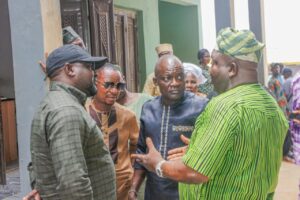
Professors Lament Low Wages, Battle Mounting Debts
Professors Lament Low Wages, Battle Mounting Debts
Some professors in the country have shared their struggles with poor remuneration, revealing how meagre salaries have pushed them into multiple loans and an unending cycle of debt.
In separate interviews, the lecturers explained that the government’s weak commitment to education has made life increasingly difficult for them and their families.
Their concerns come amid ongoing agitation by the Academic Staff Union of Universities (ASUU), which has repeatedly criticised the Federal Government for prioritising pay increases for politicians while neglecting academics.
ASUU’s National President, Emmanuel Piwuna, attributed the stagnant salaries of university lecturers to chronic government neglect.
He argued that the disregard for academics has crippled universities’ ability to attract quality staff, dampened morale, and reduced academic output.
Data on professors with less than 10 years on the professorial cadre in African public universities show that Nigerian lecturers rank among the worst paid on the continent, with professors earning an average of $366 (about N500,000) monthly.
While a Nigerian professor earns about $4,400 annually, a South African counterpart takes home $57,471, more than 13 times higher.
Uganda follows with $50,595 per annum, then Kenya with $48,000. Even countries with far smaller economies than Nigeria, such as Eswatini ($41,389), Lesotho ($32,455), and Gabon ($29,907), pay significantly better.
Shockingly, Nigeria also trails Sierra Leone ($18,000), Zambia ($14,949), and Comoros ($12,960), despite being Africa’s largest economy.
‘We survive on loans’
Speaking to the press,several university professors painted grim pictures of their declining standard of living caused by poor remuneration.
They argued that by earning about N500,000 monthly, some of them are forced to squat in staff quarters, while others compete with students for seats on buses meant for undergraduates.
Prof. Adebowale Adejumo of the Department of Statistics, University of Ilorin, lamented that the situation was pushing many academics into crippling debts and multiple side jobs in order to survive.
He stressed that despite the 2009 agreement signed with the Federal Government, nothing had been implemented, leaving professors underpaid and demoralised.
Adejumo revealed that he had been compelled to take multiple loans to pay his children’s school fees, as they all attend private universities due to incessant strikes in public institutions.
He lamented, “All my children are in private universities because of strikes. I have to do different jobs and take loans just to meet up. For almost a year now, I hardly drive my car to work because of the cost of fuel. Anytime I drive, I spend at least N10,000 on fuel just for that day. If I do that every day, how much is left for feeding and other expenses?”
Comparing Nigerian lecturers’ pay with that of their counterparts abroad, Adejumo described the disparity as shameful. “When we convert what we earn to dollars, it is just about $320. In South Africa, colleagues like me earn $10,000 or $11,000 monthly. Even in Namibia, a friend of mine earns $7,000 during his sabbatical,” he added.
Another professor based in Enugu, who preferred not to be named, said poor salaries had left many of his colleagues drowning in debt from unpaid loans. “The salary of professors in Nigeria cannot sustain me alone, let alone my wife and children,” he said.
The plight of these professors underscores the widening gap between academic labour and fair compensation in Nigeria. With the rising cost of living, stagnant wages, and neglect of the education sector, many fear that the country risks losing its brightest minds unless urgent reforms are made to improve the welfare of university lecturers.