World Bank Backs 90,000km Fibre Optic Rollout, Applauds Nigeria’s Digital Reform Efforts
World Bank Backs 90,000km Fibre Optic Rollout, Applauds Nigeria’s Digital Reform Efforts

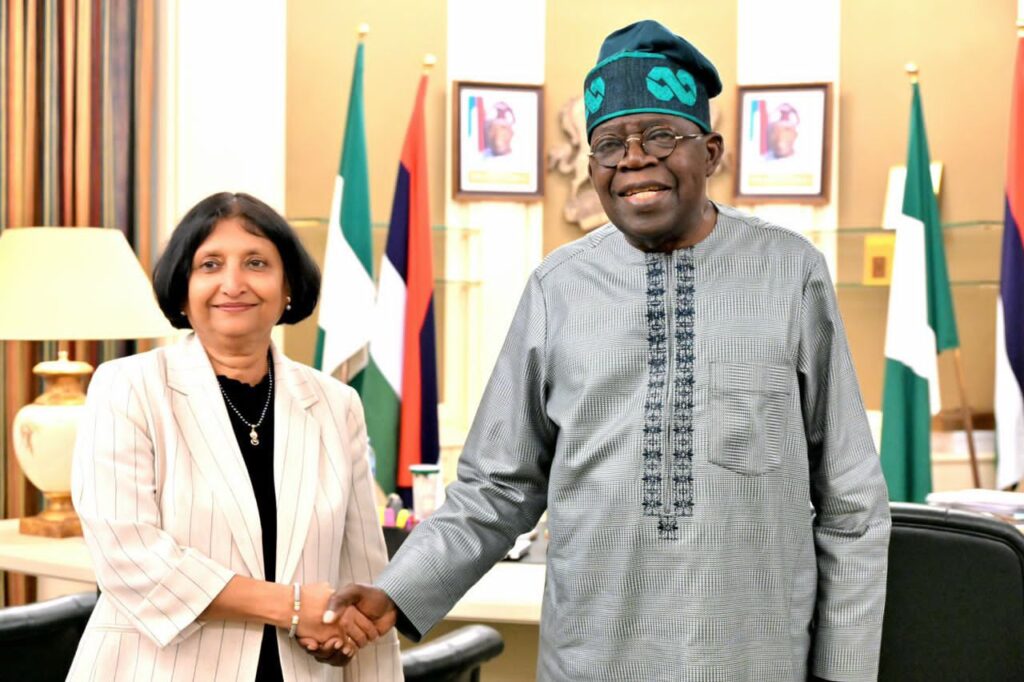
World Bank Group Managing Director and Chief Financial Officer, Anshula Kant, on Wednesday, reaffirmed the Bank’s support for Nigeria’s ambitious plan to deploy a 90,000-kilometre national fibre-optic network—one of the largest initiatives of its kind globally.
Kant also commended President Bola Tinubu’s “ambitious macro-economic reforms,” describing the collaboration between Nigeria and the World Bank as strong and ongoing.
“We are working very, very closely together on this,” she told reporters following a meeting with President Tinubu at the Aso Rock Presidential Villa.
Accompanied by the World Bank Country Manager, Taimur Samad, Kant noted that the Bank maintains a robust partnership with Nigeria. She highlighted that one of the most significant upcoming projects will focus on expanding digital infrastructure and delivering broadband access across the country.
And then we have projects in the agribusiness. We have projects in the agribusiness space. We have projects in the energy space. We have projects in the social protection, education, health space.”
She described Nigeria as a “very, very valuable and important partner” for the World Bank Group, congratulating the country and the President for “embarking on such ambitious reforms and staying the course.”
“They are not easy to do, but already you can see the big improvements and forward momentum that is taking place in Nigeria,” Kant stated.
She said the World Bank Group has embarked on a mission to eradicate poverty on a livable planet, which involves accelerating growth and creating better jobs for young people.
“Access to energy, access to digital services, higher productivity in agriculture, better health and education, these are our shared priorities with Nigeria,” she stated.
Kant’s visit, which is her first to Abuja since Tinubu assumed office in May 2023, came as the administration tries to stabilise the naira, curb inflation and court investment after scrapping fuel subsidies and unifying exchange rates.
The World Bank already runs a $9bn portfolio in Africa’s biggest economy, spanning power, agriculture and social protection.
Meanwhile, the Finance Minister and Coordinating Minister of the Economy, Wale Edun, said Kant’s delegation discussed “the overall partnership” and, in particular, the fibre rollout, which will expand Nigeria’s backbone from 35,000km to 125,000km and is being structured as a self-financing special-purpose vehicle.
“It is geared at the sector which will make use of the facility, pay for it and therefore make the project highly viable,” Edun told reporters.
The Minister of Communications, Innovation and Digital Economy, Bosun Tijani, called the scheme “once-and-for-all” infrastructure that will ring every geopolitical zone and feed fibre “into homes, schools and hospitals.”
He said the Federal Government will take a minority stake while the private sector supplies 51 per cent of funding; the World Bank and other development financiers are expected to inject at least $500m.
We can’t become smarter with agriculture, scale education or deliver modern healthcare without good connectivity.
“There are few investments that can add 1.35 percentage points to GDP for each 10 per cent jump in broadband quality,” Tijani said, adding that digging should start by year-end once detailed route maps are published.
According to him, presidential backing secured Federal Executive Council approval for a 90,000km national fibre-optic backbone.
Nigerians often complain about poor connectivity, but service quality is determined by the underlying infrastructure, he noted.
He said FG, therefore, intends to “fix this once and for all,” delivering fibre-based links to homes, offices, schools and hospitals.
Tijani outlined a ring design that covers every geopolitical zone and fills the gaps in each state. Once complete, he said, fibre will reach local neighbourhoods.
He explained that the World Bank is assisting in structuring a special-purpose vehicle (SPV) into which the Nigerian government and private sector partners will jointly invest, with private investors expected to contribute 51 per cent of the total funding.
The SPV, which will operate independently of government control, will be sustained through user fees, making the broadband project self-financing rather than reliant on loans.
Describing the initiative as an investment that “will keep giving,” he emphasised that reliable connectivity is now the backbone of every sector. According to him, Nigeria’s creative industry, precision agriculture, education, and healthcare systems cannot achieve full potential without strong broadband infrastructure.
The minister noted that the project design is complete and that a public route map will be released within two months, paving the way for construction to begin before the end of 2025.
The World Bank’s current engagement in Nigeria includes $1.5 billion for power sector recovery, $700 million for adolescent girls’ education, and $500 million for rural road development.
Anshula Kant added that upcoming projects will focus on broadband expansion, agribusiness value chains, and renewable energy. She also revealed that the World Bank is collaborating with Nigeria to design a concessional finance window aimed at supporting small and medium-sized enterprises.